

Marketers have spent years measuring search visibility through rankings, impressions, clicks and traffic. AI-generated answers are changing that picture. Instead of asking “Are we ranking?”, the question increasingly becomes: “Are we showing up in AI answers, and how do we compare with our competitors?”
AI visibility measurement is still evolving, but AI share of voice is emerging as a useful metric for assessing a brand’s visibility in AI answers. It provides a way to benchmark your visibility relative to competitors. But a single score only tells part of the story. At EMNA AI, we look at AI visibility through three measurement layers:
- Presence: Is your brand appearing?
- Position: How is your brand appearing?
- Progress: Is your brand’s visibility improving?
In this article, we’ll explain what AI share of voice measures, how to interpret it and which other metrics help give you a more complete picture of your AI visibility.
What is AI share of voice?
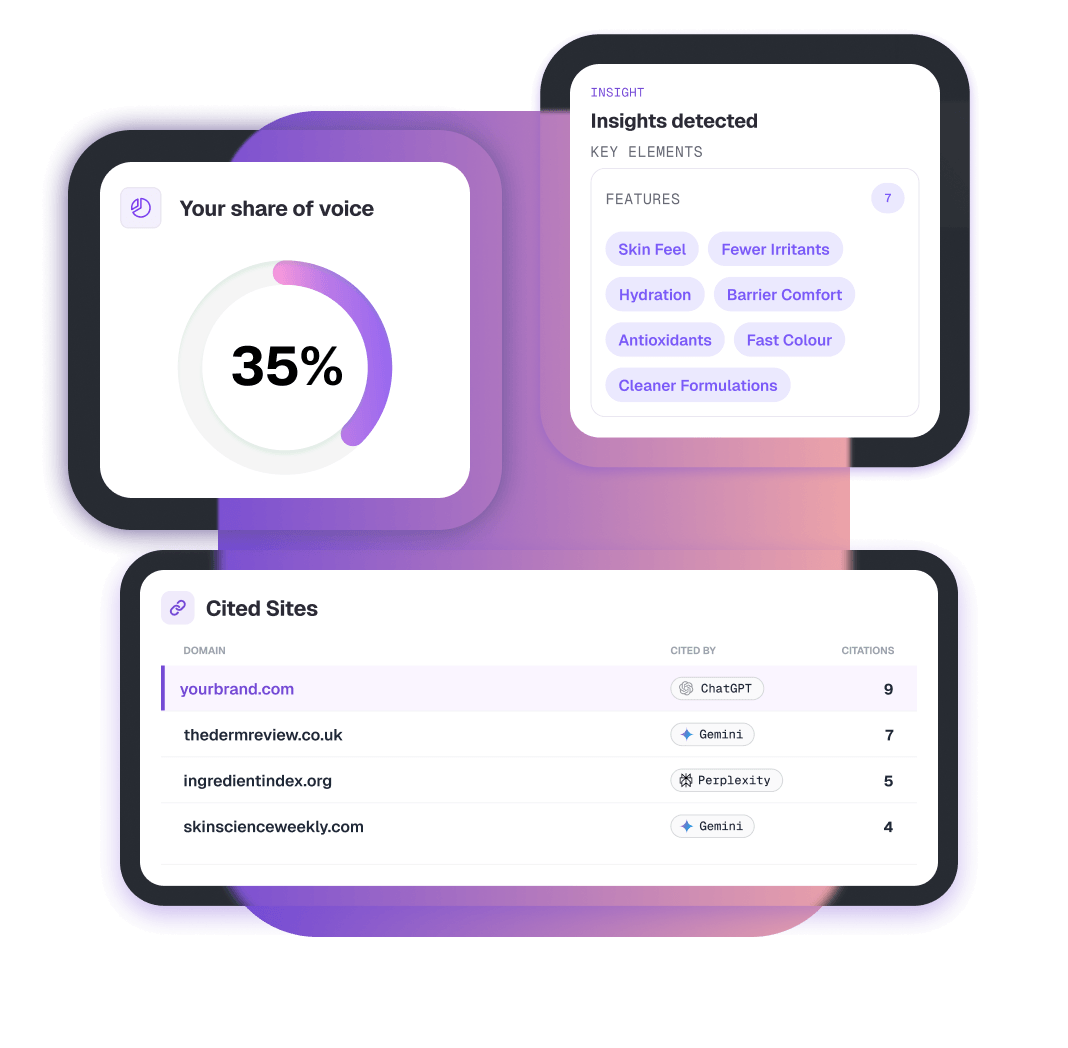
AI share of voice measures how frequently your brand appears across a defined set of relevant AI-generated answers relative to competing brands. It gives marketers a way to benchmark brand visibility across the questions their audiences are asking and understand who is currently capturing more of that visibility.
For example, imagine a skincare brand analysing AI answers around moisturisers for sensitive skin. If competing brands consistently appear across relevant research, comparison and recommendation prompts while your brand rarely does, AI share of voice helps quantify that competitive gap.
The prompts behind the score
An AI share of voice score only makes sense in the context of the prompts you measure. A brand may look highly visible if the analysis focuses on questions that already include its name, while appearing far less often when customers ask broader category or recommendation questions.
The prompt set should therefore reflect the questions your target audience is likely to ask when researching and choosing products or services. It should also reflect the market and customer personas you actually want to reach.
AI share of voice is only meaningful when it is measured against prompts that reflect the real questions your audience asks.
AI share of voice is only a starting point
A headline score like AI share of voice can tell you how your overall visibility compares with competitors, but it cannot tell you everything about that visibility.
Two brands could have a similar share of voice while appearing in very different ways. Both might be mentioned in a similar number of answers, but while Brand A is consistently positioned as a leading choice, Brand B appears without being strongly recommended.
Visibility can also differ significantly between AI platforms. Your brand might have a high AI share of voice in ChatGPT, while its visibility is lower in Gemini or Perplexity. That is why AI share of voice should be interpreted alongside other metrics, such as recommendation presence or platform performance.
AI share of voice is a competitive visibility metric, not a complete picture of your brand’s AI visibility.
Presence: is your brand appearing?
The first layer of AI visibility measurement is presence: does your brand appear in the answers that matter to your audience?
Start by looking at how consistently your brand appears across your priority prompts. For our skincare brand, that could mean comparing its presence across questions such as “What is the best moisturiser for sensitive skin?” or “Which moisturiser do you recommend for dry, reactive skin?”
Look beyond overall presence
An overall visibility score can hide important differences. Your brand might appear frequently in general research questions, for example, but be largely absent when consumers ask for comparisons or specific recommendations. So, rather than asking only, “Are we appearing?”, look at where you appear and where you do not.
That could include differences between:
- research, comparison and recommendation prompts;
- customer needs or use cases;
- markets or personas;
- branded and non-branded questions.
This gives you a clearer picture of the parts of the customer journey where your brand is already visible and where competitors may be capturing more attention.
Presence answers the first measurement question: how often does your brand appear across the prompts that matter?
Position: how is your brand appearing?
Presence tells you whether your brand makes it into an AI answer. Position looks at what happens once it gets there.
A mention alone does not tell you whether your brand is being presented as a strong option. Look at how it is described, which attributes it is associated with, whether it is compared with competitors and, most importantly, whether it is actually recommended.
Compare your position with competitors
AI visibility is competitive, so your own position becomes more meaningful when you compare it with the brands appearing alongside you.
Look at questions such as:
- Which brands are recommended most consistently?
- What attributes or use cases are competitors associated with?
- Is your brand presented as a leading option, an alternative or simply mentioned?
- Are competitors repeatedly stronger for particular customer needs?
This helps you move beyond counting appearances and understand the role your brand plays within the answer.
Compare platforms and understand the sources
Position can differ between ChatGPT, Gemini, Perplexity and other platforms. Your brand may be frequently recommended on one platform but appear less consistently – or in a different context – on another.
Where citation information is available, sources add another useful layer. Looking at which websites and pages are cited can help you understand which sources are associated with your visibility and that of your competitors. You do not need to analyse sources in isolation here. The goal is to understand whether your visibility, competitive position and supporting sources differ by prompt or platform.
Position answers the second measurement question: when your brand appears, what role does it play in the answer and how does that compare with your competitors?
Progress: is your brand’s visibility improving?
Presence and position tell you where your brand stands today. Progress tells you whether that position is changing over time.
A single measurement gives you a useful baseline, but it cannot tell you whether your visibility is improving, declining or simply fluctuating. To understand progress, compare performance consistently across the prompts, competitors and AI platforms that matter to your brand.
Measure against a consistent baseline
Where possible, keep a stable core set of priority prompts and competitors so you can compare like with like over time. If the questions or competitive set change significantly between measurements, it becomes harder to understand whether your visibility has actually moved.
Look for changes such as:
- Is your brand appearing across more priority prompts?
- Is your AI share of voice increasing relative to competitors?
- Are you being recommended more consistently?
- Has your competitive position changed?
- Is visibility improving across multiple AI platforms?
- Are the sources associated with relevant answers changing?
Progress answers the third measurement question: is your brand’s visibility and competitive position improving over time?
Together, Presence, Position and Progress give you a much more complete view than a headline AI share of voice score alone. But they still need to be translated into specific metrics that marketers can track consistently.
Key metrics for measuring AI visibility
AI visibility measurement is still evolving, and there is currently no universally agreed set of GEO metrics or measurement standard. Different platforms and providers may use different terminology and methodologies for measuring similar aspects of visibility.
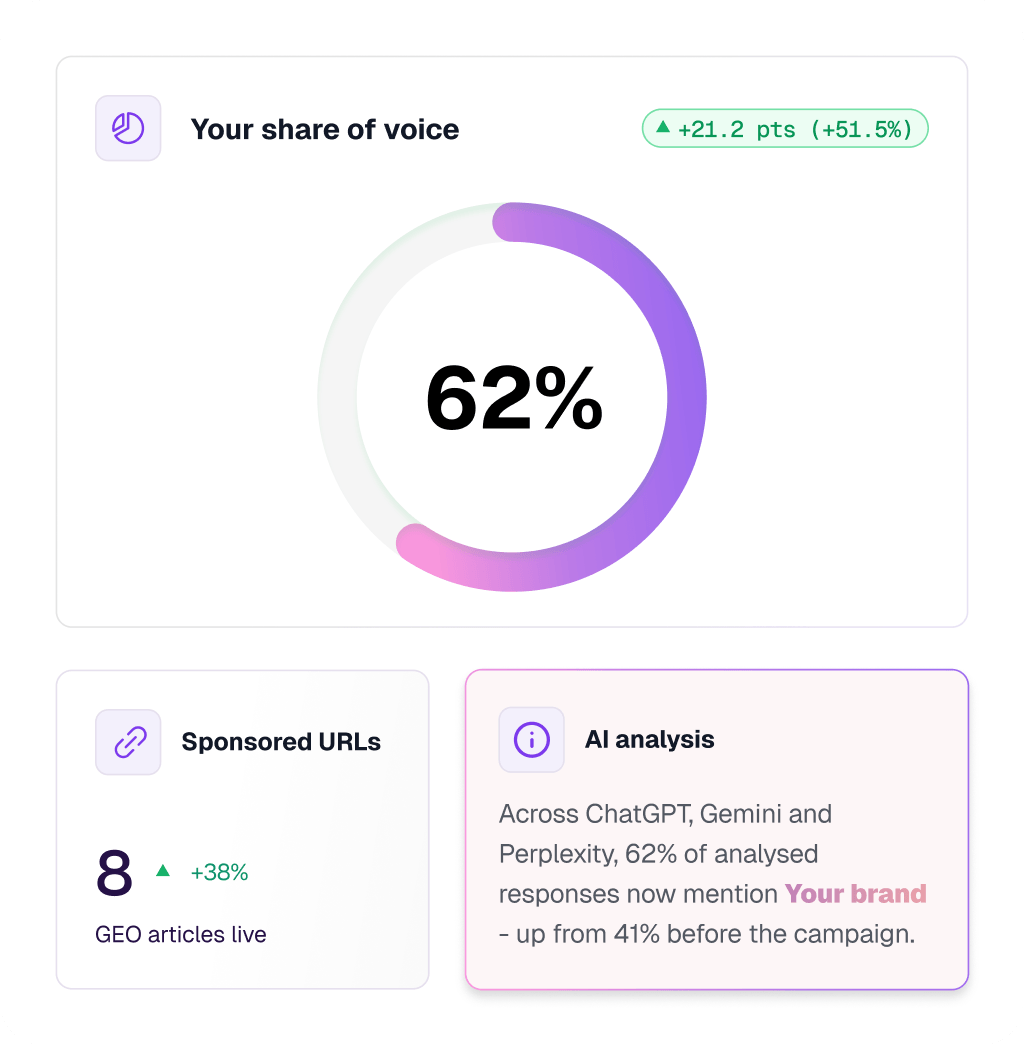
At EMNA AI, we look at a combination of metrics that help brands understand where they appear, how they appear and how their position changes over time. Our Market Intelligence provides visibility at prompt, competitor, source and platform level, while the Regenerative Score adds a broader view of the signals behind a brand’s AI visibility.
| Metric | What it helps you understand |
| AI share of voice | How visible is your brand relative to competitors across your priority prompts? |
| Prompt coverage | Across how many of your priority prompts does your brand appear? |
| Recommendation presence | How often is your brand recommended rather than simply mentioned? |
| Competitor visibility | Which competitors appear most consistently alongside or instead of your brand? |
| Description & sentiment | How is your brand being described, and is that representation accurate and positive? |
| Source & citation presence | Which sources are associated with relevant answers and brand visibility? |
| Platform performance | How does your visibility differ across ChatGPT, Gemini, Perplexity and other AI platforms? |
| Trend over time | Is your visibility and competitive position improving, declining or remaining stable? |
No single metric fully captures AI visibility. AI share of voice becomes more useful when viewed alongside prompt coverage, recommendation presence, competitor visibility, description and sentiment, source intelligence, platform performance and trends over time.
Together, these metrics help explain what sits behind the headline score. But they also raise an obvious question: what AI share of voice should your brand actually be aiming for?
What is a good AI share of voice?
There is no universal percentage that defines a “good” AI share of voice. The number needs to be understood in context. Your competitive landscape, market, priority prompts and AI platforms all influence what a meaningful share of voice looks like. A brand competing in a fragmented category with many alternatives, for example, should not necessarily expect the same share of voice as a market with only a handful of established competitors.
Instead of aiming for an arbitrary percentage, focus on two benchmarks:
1. Your relevant competitors
Compare your share of voice with the brands competing for the same questions and customer needs. Are you leading, keeping pace or consistently underrepresented?
This makes AI share of voice a relative measure rather than an isolated score. A 30% share of voice means very little without knowing how competitors perform across the same prompt set.
2. Your own baseline
Your starting position provides the second important benchmark. Is your share of voice improving over time? Are you appearing across more priority prompts or gaining visibility relative to competitors?
Tracking progress against your own baseline helps show whether your position is moving in the right direction, even if you are not yet leading the category.
A good AI share of voice is not a universal percentage. It is a competitive benchmark that should be interpreted against the brands, prompts, markets and platforms that matter to your business.
From measurement to action
AI share of voice gives you a competitive benchmark, while Presence, Position and Progress help explain what sits behind that number. Together, these insights can show you where your brand is underrepresented, which competitors are gaining more visibility, and which prompts, platforms or sources deserve closer attention.
The next step is to turn those gaps into action – whether that means strengthening existing content, answering missing customer questions or building greater visibility across relevant third-party sources.
Ready to take the next step? Read our guide to improving your brand’s visibility in AI answers.
Or talk to our team – we’d be happy to discuss where your brand stands today and where the biggest opportunities your AI visibility lie.
