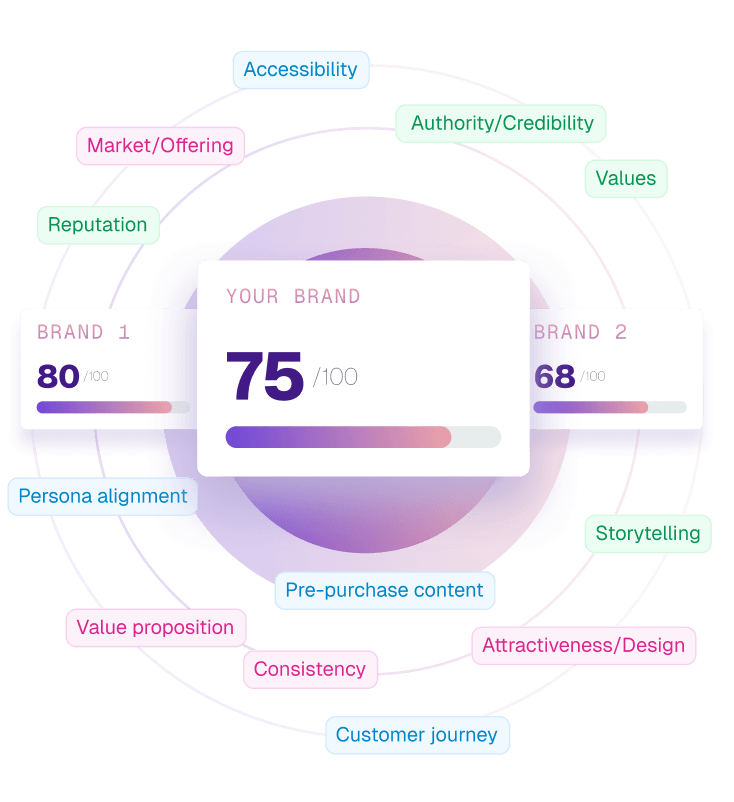

BENCHMARK YOUR BRAND

Your Regenerative Score

See how your brand compares across 12 strategic pillars, where it is strongest and what could improve its visibility in AI-generated answers.

RegenerativeScore mobile (1)
Accessibility
Authority/Credibility
Values
Market/Offering
Reputation
Persona alignment
Storytelling
Pre-purchase content
Value proposition
Attractiveness/Design
Consistency
Customer journey
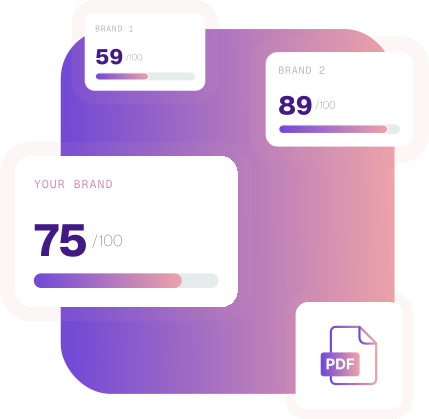
BRAND 1
80 /100
BRAND 2
68 /100
YOUR BRAND
40 /100

Network of 180,000+ publishers

Measurement and execution, in one place.

Overall brand score

Compare your performance directly with selected competitors.

Strategic synthesis

Understand the market context, competitive landscape and the role each brand plays.

Detailed audit

Explore the criteria behind every score, with clear commentary on strengths and weaknesses.

Actionable priorities

Identify the areas most likely to strengthen your brand and improve its visibility.

Emna img2
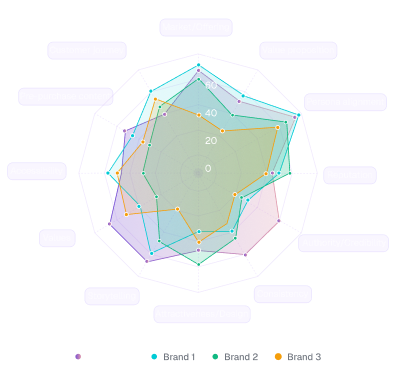
The visibility framework

A complete view of the signals behind AI visibility.

When a buyer asks AI about your brand, the answer is primarily built from what others publish about you.

Market/Offering
Pre-purchase content
Customer journey
Accessibility
Values
Storytelling
Attractiveness/Design
Consistency
Authority/Credibility
Reputation
Persona alignment
Value proposition
80 60 40 20 0
Your brand
Brand 1
Brand 2
Brand 3
Regenerative Score spider graph mobile
Brand capital
  • Reputation
  • Authority and credibility
  • Storytelling
  • Values
Offer and perception
  • Market and offering
  • Value proposition
  • Attractiveness and design
  • Consistency
Conversion
  • Persona alignment
  • Accessibility
  • Customer journey
  • Pre-purchase content
How it Works

From audit to action.

01
Define the scope

Choose your brand, competitors, market and strategic focus.

02
Analyse performance

EMNA assesses every brand using the same 12-pillar framework.

03
Compare the results

See where your brand leads, where it falls behind and how competitors differ.

04
Prioritise action

Use the findings to guide brand, content and campaign decisions.

Get a personalised AI brand-visibility audit.

Export a shareable report containing your overall score, competitor comparison, strategic synthesis and pillar-level analysis.

The report includes:

  • Overall brand scores
  • Market and competitor analysis
  • Criterion-level scoring
  • Visual pillar comparison
  • Strategic recommendations
Regenerative Score YOUR PERSONALISED OUTPUT
Regenerative Score FROM INSIGHTS TO ACTION

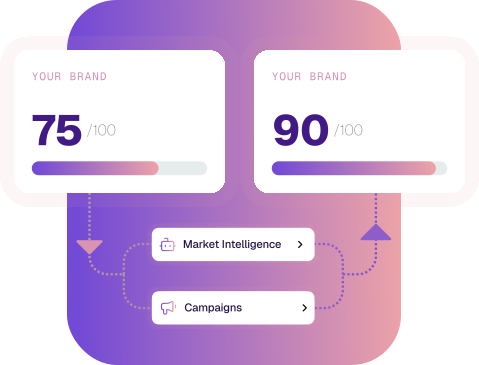
Use your score to shape what happens next.

Take the findings into Market Intelligence, Content Hub and Campaigns to strengthen how your brand appears in AI-generated answers.

MORE CAPABILITIES

Explore other platform features.

emnaicon opacity

Discover what is shaping your AI visibility.

See how your brand compares, where the gaps are and where to focus next

Support

FAQs

Everything you need to know about the product and billing. Can’t find the answer you’re looking for? Please chat to our friendly team.

What is EMNA’s Regenerative Score?

EMNA’s Regenerative Score is a comparative brand assessment across 12 pillars. It examines your brand’s strengths and weaknesses alongside selected competitors, with scores out of 100 and AI-generated qualitative commentary.

The assessment covers how your brand presents its offering, establishes credibility and supports the customer journey. It helps identify areas that deserve attention, such as an unclear value proposition or gaps in content that helps customers assess a purchase.

The score is a brand-assessment benchmark. It is not the percentage of AI answers mentioning your brand or the probability that an AI platform will recommend it.

The 12 pillars are organised into three areas:

Brand capital

  • Reputation
  • Authority/Credibility
  • Storytelling
  • Values

Offer and perception

  • Market/Offering
  • Value proposition
  • Attractiveness/Design
  • Consistency

Conversion

  • Persona alignment
  • Accessibility
  • Pre-purchase content
  • Customer journey

Together, these provide a structured view of the brand, its offering and the experience it presents to potential customers. Each pillar receives a comparative score and commentary to help explain the assessment.

These are EMNA’s brand-assessment criteria. They should not be interpreted as 12 published ranking factors used by AI platforms.

The assessment applies the same 12-pillar framework to your brand and selected competitors. It presents overall scores, individual pillar scores and qualitative analysis of the differences.

Looking at the pillars can be more useful than looking only at the overall score. A brand might compare well on authority and reputation but less favourably on value proposition or pre-purchase content. Those findings suggest different priorities from a broad instruction to “improve the brand”.

The results support investigation and planning. They are qualitative assessments, not customer survey results or a direct measurement of market share.

Regenerative Score assesses the brand across 12 pillars. Market Intelligence examines its observed presence in selected AI-generated answers, including competitors and cited sources.

The two can therefore reveal different things. A brand may receive a strong authority assessment but still appear infrequently for a particular buying question. That would prompt the team to investigate the content and sources associated with that question.

EMNA considers both views when planning activity: the comparative brand assessment helps identify potential weaknesses, while answer monitoring shows where visibility gaps are observed. A higher Regenerative Score does not automatically mean greater AI Share of Voice.

EMNA uses the pillar findings to identify areas for further investigation, then considers them alongside Market Intelligence and your commercial priorities.

For example, a weaker pre-purchase content assessment may prompt a review of the information available to customers comparing your products. If monitored AI answers also reveal gaps around those buying questions, the combined findings can support a focused content brief.

Other findings may suggest improvements to messaging or the customer journey rather than a publisher campaign. Our team explains which actions fit the agreed scope and which are recommendations for your wider marketing team.

The aim is to turn the assessment into specific priorities, rather than treat an increased score as an objective on its own.

Scroll to Top