
Knowing where your brand appears in AI answers is an important first step. But measurement alone will not improve your visibility. Once you know where the gaps are, you can start taking steps to influence how your brand appears.
To improve your AI visibility, focus on the prompts that matter, create useful content that makes your relevance clear, strengthen your presence across credible third-party sources and track how your position changes over time. This approach is often referred to as Generative Engine Optimization (GEO): improving how your brand is understood, surfaced and recommended in AI-generated answers.
While there is no single tactic that guarantees visibility, brands can take a structured approach to improving the information environment around them.
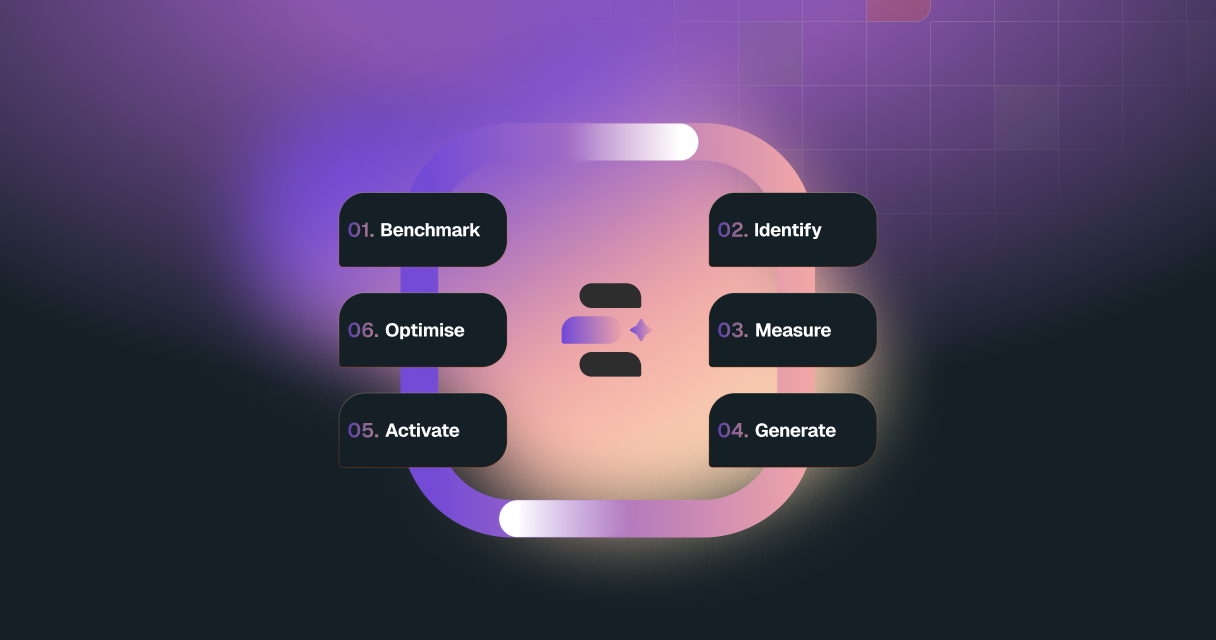
At EMNA AI, we approach this as a continuous cycle:
- Measure where your brand stands today.
- Prioritise the visibility gaps that matter most.
- Create content that strengthens your relevance.
- Activate relevant third-party sources.
- Track how your visibility changes.
- Optimise based on what the data tells you.
In this article, we’ll take you through each step and show how to turn AI visibility insights into actions that can strengthen your brand’s position over time.
1. Measure where your brand stands today
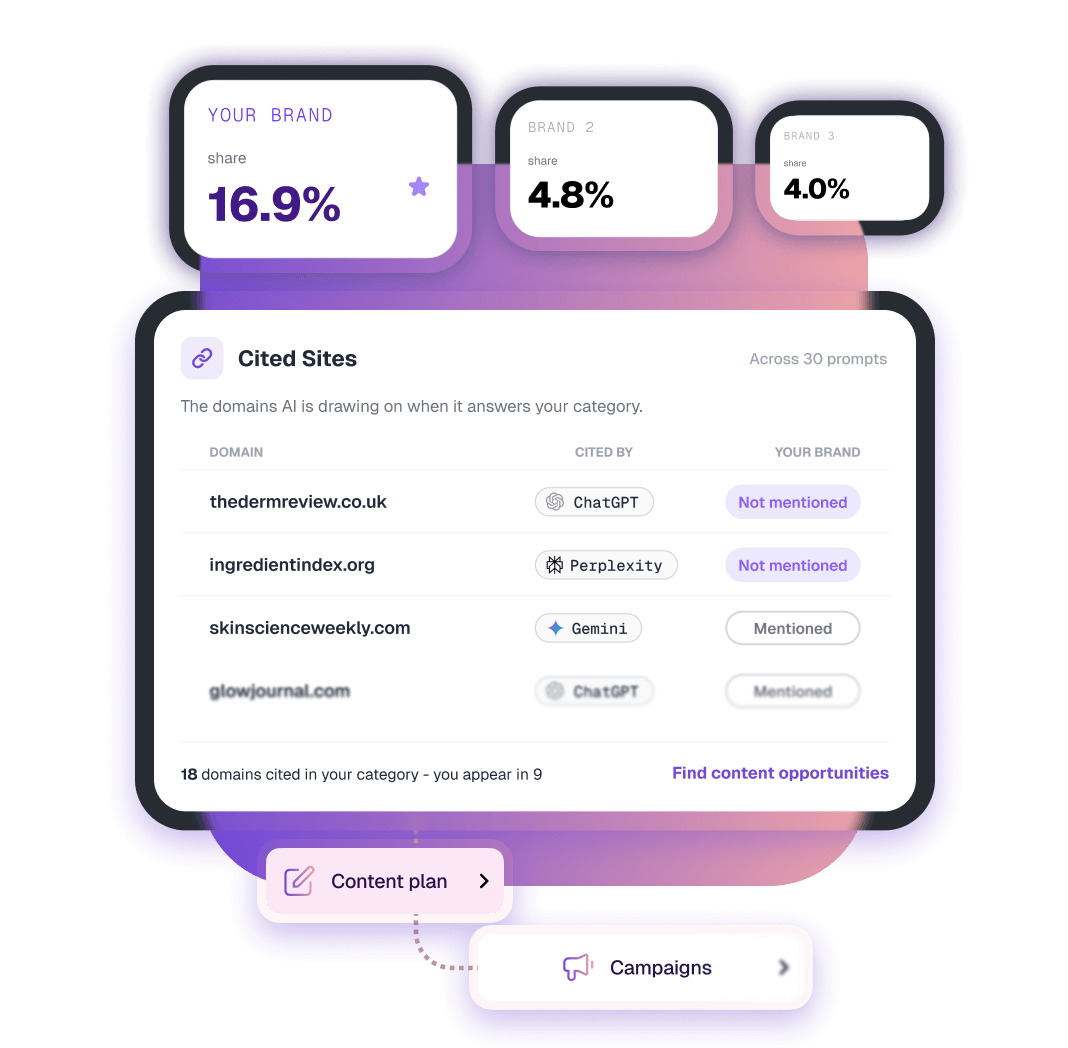
Before trying to improve your AI visibility, you need a clear baseline. That means understanding how often your brand appears for the prompts that matter, how you compare with competitors and whether your visibility differs across AI platforms.
Start with a defined set of prompts that reflect how your audience researches, compares and chooses products or services. Then look beyond simple brand mentions. Is your brand being recommended? Which competitors appear instead? How is your brand described? And, where citations are available, which sources are shaping those answers? For a deeper look at how to identify these visibility gaps, read our guide to why your brand may not be showing up in AI answers.
It is also important to compare performance across platforms. A brand that appears frequently in ChatGPT may have a different position in Gemini or Perplexity, so measuring only one platform can give you an incomplete picture.
At EMNA AI, we bring these signals together through AI share of voice, prompt-level analysis, competitor comparison and source intelligence to create a baseline you can track over time.
You cannot improve AI visibility consistently if you do not first establish what “visible” means for the prompts, competitors and platforms that matter to your brand.
2. Prioritise the visibility gaps that matter
After establishing your baseline, you may find dozens, or even hundreds, of prompts where your brand could improve its visibility. Focus on the gaps that matter commercially and where your brand has a credible reason to be considered.
Focus on the prompts closest to customer decisions
Not every prompt carries the same value. A broad research question may help someone understand a category, while a comparison or recommendation prompt can sit much closer to an actual purchase decision.
Consider a hotel in Lisbon that rarely appears for the prompt: “What are the best family-friendly hotels in Lisbon with a pool and easy access to the city centre?”
If the hotel genuinely offers family rooms, a pool and a central location, that visibility gap is potentially valuable. The prompt reflects a relevant audience, clear customer requirements and strong consideration intent. By contrast, there is little value in trying to build visibility for prompts where the hotel is not a genuine fit.
Look for gaps you have a credible reason to close
Prioritisation should therefore combine commercial value with brand relevance.
Ask:
- Is this a question our target audience is likely to ask?
- Does it relate to a product, service or market that matters to the business?
- Does our brand genuinely meet the needs expressed in the prompt?
- Are competitors being recommended where we are currently absent or underrepresented?
This helps narrow a large visibility landscape into a smaller set of opportunities worth acting on.
The goal is not to appear in every AI answer. It is to improve visibility for the questions where your brand has a credible reason to be considered.
3. Create content that strengthens your relevance
Once you know which visibility gaps to prioritise, look at the information available about your brand. Does your existing content clearly explain why your product or service is relevant to the questions you want to appear for?
Instead of publishing more content for the sake of it, brands need to create or improve content that fills genuine information gaps.
Create content around customer decisions
Start with the information a customer needs to decide whether your brand fits their needs. That might include relevant use cases, product features, differentiators, value proposition or evidence supporting your claims.
Take our Lisbon hotel example. If the hotel wants to be considered for family-friendly recommendations, describing itself simply as a “welcoming hotel in central Lisbon” provides limited useful context. Clear information about family rooms, children’s facilities, the pool, transport connections and proximity to relevant attractions gives a much better picture of why the hotel may fit that particular need.
The same principle applies to broader editorial content. Rather than creating another generic article about family holidays in Lisbon, the hotel could address questions that help people make a decision: which areas of Lisbon are easiest to explore with children, what families should look for when choosing a hotel, or which facilities can make a city break with young children easier.
Fill the questions your existing content does not answer
Next, look at the questions behind your priority prompts. Are they answered clearly on your website, or is important information missing, fragmented or difficult to find?
This may create opportunities for new content, but it can also mean improving what already exists. Product and service pages, FAQs, buying guides, comparison pages and editorial content can all help answer different questions across the customer journey.
Keep important information accurate and current
Creating useful content is not a one-off task. Product details, prices, availability, services and other information can change, and outdated information can weaken the picture available about your brand.
Review priority content regularly and update it when something meaningful changes. The aim is to make sure the information available about your brand remains clear, consistent and useful for the questions you want to be associated with.
GEO-friendly content should help answer a real research, comparison or recommendation question while making it clear why your brand is relevant to that need.
4. Activate relevant third-party sources
Creating strong content on your own website is important, but it is only part of the picture. Third-party sources play an important role in the answers around your priority prompts, so your GEO strategy should also consider how your brand is represented across those sources.
Start with the sources already shaping your priority prompts
Look at the publishers, review platforms, specialist websites and other third-party sources that repeatedly appear around the prompts you have prioritised.
For our Lisbon hotel, that might include travel publications, destination guides, family-travel websites or hotel comparison and review platforms covering questions about where families should stay in the city.
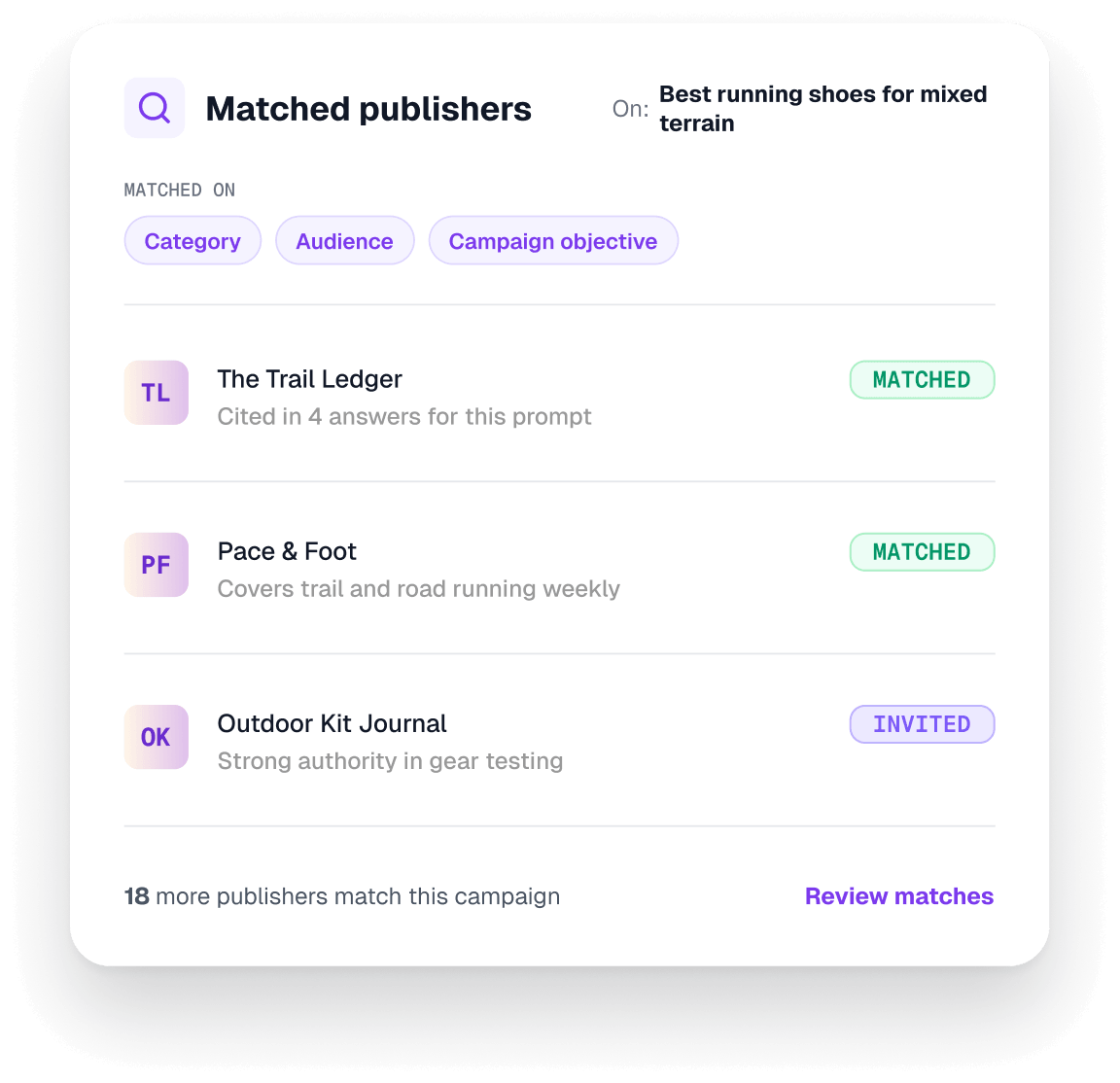
If a relevant publisher is already a partner, there may be an opportunity to deepen the relationship and develop content around the topics or questions where your visibility is weak. If the publisher is not yet part of your partner mix, consider whether there is a relevant editorial or commercial opportunity to build that relationship.
Match the content to the source
The right publisher is only half of the equation. The content itself needs to make sense for that publisher and its audience.
A family-travel publication, for example, might publish a practical guide to what makes a hotel genuinely family-friendly, while a Lisbon destination site could compare hotels based on location, transport links and proximity to major attractions. The objective is to contribute useful content around the questions people are actually asking, rather than simply reproducing brand messaging on a third-party site.
Prioritise relevance over volume
A smaller number of well-matched placements can be more valuable than a large number of generic mentions. Look for publishers with genuine relevance to the topic, audience or market you want to strengthen.
This is where EMNA AI goes beyond visibility measurement. Through our network of more than 180,000 publishers, brands can activate GEO-focused content with relevant media and content partners, connecting the visibility gaps identified in the platform with third-party activation.
The goal is not to be mentioned everywhere. It is to be present in the right sources, around the right questions, with information that strengthens your relevance.
5. Track how your visibility changes
Once your content and third-party activation are live, the next step is to measure whether your AI visibility changes over time.
Avoid judging success based on a single ChatGPT, Gemini or Perplexity answer. Instead, return to the baseline you established at the beginning and track performance across the same priority prompts, competitors and platforms.
Alongside overall presence, look at changes in:
- AI share of voice: Is your visibility increasing relative to competitors?
- Prompt coverage: Are you appearing across more of the priority questions?
- Recommendations: Are you being recommended, rather than simply mentioned?
- Competitive position: Are the same competitors still dominating the answers?
- Sources and citations: Are your content and relevant third-party sources appearing around those answers?
- Platform performance: Is progress consistent across ChatGPT, Gemini and Perplexity, or stronger on certain platforms?
AI visibility should be treated as a moving competitive metric, not a one-time search result.
If you want to go deeper into how to measure these signals, read our AI visibility measurement guide.
6. Optimise based on what you learn
AI visibility is not something you optimise once and consider finished. AI answers change, competitors publish new content and the questions your customers ask evolve.
Use what you learn from tracking to decide where to focus next. That might mean adjusting priority prompts, updating content, strengthening publisher relationships or activating new opportunities.
Then repeat the cycle:
Measure → Prioritise → Create → Activate → Track → Optimise
The aim is not to optimise for one AI answer. It is to build and maintain stronger visibility around the questions that matter to your audience.
Turn AI visibility insights into action
EMNA AI helps you identify the visibility gaps that matter, create content around priority opportunities and activate relevant publishers through a network of more than 180,000 partners – while tracking how your AI visibility changes over time.
Ready to strengthen your visibility in AI answers? Talk to our team or explore the EMNA AI platform.
