
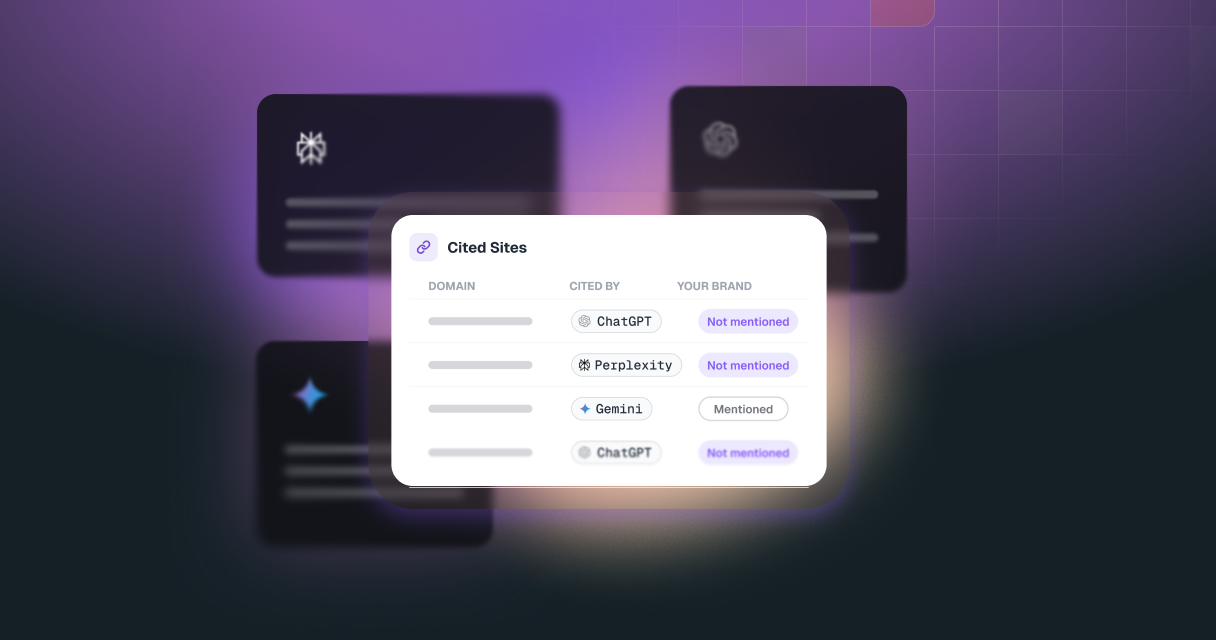
Imagine asking ChatGPT, Gemini or Perplexity a question that is clearly relevant to the products or services you offer. Your brand is missing, while a competitor appears instead. Or your brand gets a passing mention, while another is presented as the better choice.
AI is changing how consumers discover and compare brands, creating a new visibility question: How do brands make sure they are not only mentioned, but recommended in AI answers? For marketers, a strong search ranking is no longer the whole picture. Visibility increasingly depends on how brands appear across AI-generated answers too.
If your brand is not showing up in AI answers, three things are worth investigating first:
- the prompts you are measuring,
- the context surrounding your brand, and
- the sources shaping the answer.
Together, they help explain why one brand appears, another is recommended and a third is missing altogether. In this article, we’ll look at how prompts, context and sources shape your AI visibility and how to identify where the gaps are.
Start with the prompts you are measuring
Before asking whether your brand appears in AI answers, you should take a step back and look at the prompts you are using to measure that visibility.
Branded prompts can create a false sense of visibility
If you ask an AI platform a question that already includes your brand name, you are giving it a strong signal about what to talk about. For example: “Is Brand X a good laptop brand?”
That can be useful if you want to understand how your brand is described. But it does not tell you much about whether people will discover you when they have not already decided to look for you. In other words: branded prompts can overstate how visible a brand appears. A more useful view comes from looking at broader category and product questions that consumers are likely to ask before choosing a brand.
Measure the prompts that shape discovery
The more revealing prompts are often the ones people ask earlier in the decision journey – when they are still researching a need, comparing options or looking for a recommendation.
For example, for a consumer electronics brand, that could include:
- Research: “What should I look for in a laptop for university?”
- Comparison: “Which laptops offer the best balance of battery life and performance?”
- Recommendation: “Can you recommend a laptop for university that’s lightweight but still good for design work?”
These prompts show whether your brand appears for the questions that matter before a buyer has chosen which brand to consider.
AI visibility should be measured against the questions buyers ask about the category, not only questions that already contain your brand name.
But choosing the right prompts is only the first step. If your brand still does not appear, the next question is whether AI has enough context to understand when your brand is relevant.
Check the context surrounding your brand
Choosing the right prompts is only part of the picture. Your brand may still be missing because the information surrounding it does not clearly explain when and why it is relevant. A brand can be well known overall but weakly associated with a specific use case, audience or product requirement. A laptop brand, for example, might be widely recognised for performance but less strongly connected with student use, portability or long battery life.
Relevance depends on the situation
AI-generated answers respond to the specific context of a prompt. The same brand may therefore be a strong fit for one question and barely appear for another.
That makes positioning important. If the information available about your brand is vague, inconsistent or focused on different strengths, it may be harder for AI answers to connect your brand with the need being expressed.
Positioning gaps can become visibility gaps
A positioning gap appears when the way your brand wants to be known is not clearly reflected in the information available about it. You may, for example, want to be associated with affordability, premium quality or a specific audience, but those strengths may not be consistently communicated across your website and the wider web.
That matters because AI answers need enough clear and consistent context to connect a brand with a specific question. If that connection is weak, another brand that is more strongly associated with the relevant need may be more likely to appear instead.
At EMNA AI, we look at context across dimensions such as persona alignment, value proposition, market and offering, reputation, and authority and credibility.
AI visibility is not only about whether your brand is known. It is also about whether your brand is understood and associated with the right needs, attributes and buying contexts.
Even when your own positioning is clear, visibility is still competitive. The next question is whether other brands are supported by stronger or more relevant evidence around the same prompts.
Understand why competitors appear instead
If you see a competitor in an AI answer, the next step is to understand why they are visible for that particular prompt. A competitor may be more strongly associated with a specific feature, use case or customer need. Or they may be better represented across the sources associated with the answer.
Compare how competitors are described
Start by looking at the language used around competing brands: are they consistently associated with certain features? Are they positioned for a specific audience or use case? Do they appear more often in recommendation-style answers? Are the same attributes repeated across different prompts?
Recurring associations can reveal where competitors have built stronger relevance around a particular need.
Look for the evidence behind those associations
After analysing the language, look at the sources supporting those patterns: which publishers or websites appear repeatedly? Which individual pages are cited? Is one competitor consistently linked to a certain feature, use case or audience across several sources?
EMNA AI’s Market Intelligence approach is built around exactly this kind of comparison: looking at where a brand appears relative to competitors, then analysing the prompts, sources and topics shaping that visibility.
The important question is not only which competitor appears. It is what information is helping that competitor earn relevance for the prompt.
Look at the sources shaping the answer
Your own website is only one part of the information environment around your brand. AI-generated answers can also draw on independent publishers, reviews, community discussions, industry websites and other third-party sources.
That matters because much of the information AI systems cite about brands comes from outside the brand’s own domain. According to an Omniscient Digital analysis of more than 23,000 citations across branded prompts, owned brand content accounts for 23% of citation sources, while the majority comes from earned media and other third-party content.
Understand which third-party sources matter
Different source types can contribute different kinds of information depending on the question being asked. Common examples include:
- Independent editorial and expert media: news publications, specialist magazines, trade media and industry websites providing reporting, reviews or expert analysis.
- Review and comparison platforms: sites that compare products or collect customer ratings and experiences.
- Community and social content: forums, communities and platforms such as Reddit or YouTube, where users share firsthand experiences and recommendations.
- Commercial third-party sources: retailers, partners or other brands publishing comparisons, category guides or product information.
The source mix is not fixed. Muck Rack’s 2026 study shows that different types of questions can lead to different citation patterns, while different AI platforms may also rely on different combinations of sources.
Focus on relevance and credibility, not just volume
The goal is not simply to accumulate as many third-party mentions as possible.
A comparison article from a respected specialist publisher may provide more useful context around a specific buyer question than dozens of generic mentions. Semrush’s research, for example, highlights customer reviews, community discussions and independent publishers as recurring source types shaping brand narratives in AI discovery.
Muck Rack’s study also found authority and topical relevance matter: large, established outlets continue to appear frequently, but trade and niche publications can have a significant footprint for industry-specific questions. Recency matters too, with more than half of observed citations coming from content published within the previous 12 months.
The right question is not “How many mentions do we have?” but “Are we represented in credible, relevant sources around the prompts we want to own?”
How to diagnose your AI visibility
Once you have looked at prompts, context, competitors and sources, bring those signals together to identify where the actual visibility gap sits.
1. Map the prompts
Identify the research, comparison, use-case and recommendation questions that matter most to your audience. Avoid relying too heavily on branded prompts.
The goal is to identify the prompts where your brand has a credible reason to appear.
2. Check the answers
Look at whether your brand appears, how it is described, whether it is mentioned or recommended, and which competitors appear instead. Check whether the information is accurate and current.
3. Follow the sources
Where source or citation information is available, identify the publishers, websites and pages appearing around your priority prompts. Look for recurring sources and gaps in how your brand is represented.
4. Find the gap
Now look across the evidence and ask what is holding visibility back.
The issue might be:
- weak or unclear positioning;
- missing answers to important customer questions;
- outdated or incomplete information;
- poor visibility for high-value non-branded prompts;
- limited representation across relevant third-party sources;
- stronger competitor associations around the same need.
5. Prioritise what to fix first
Not every visibility gap deserves the same level of attention. Focus first on the prompts that matter commercially, where your brand has a credible reason to compete and where the gap is clear enough to act on.
Map the prompts. Check the answers. Follow the sources. Find the gap. Then prioritise the next action.
That gives you a much stronger starting point than simply asking whether your brand appears in one AI answer.
See how your brand appears in AI answers
EMNA AI helps you understand where your brand appears, which competitors are being recommended instead, and the prompts and sources shaping your visibility – so you can see where the biggest opportunities lie.
If you’d like to learn more, book a demo or explore our Market Intelligence page.
